Showing posts with label environment. Show all posts

Thursday, November 02, 2006

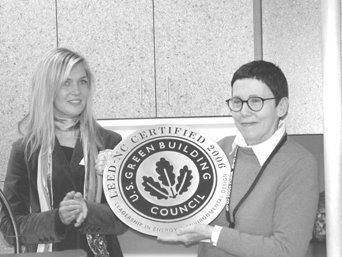
Caption: Jill Isola Johnson, LHB Interior Designer and Sharon Murphy, general manger of Whole Foods Co-op.

Whole Foods Co-op attains LEED (Green) certification


Whole Foods Co-op not only stocks its shelves with healthy, organic food, its building is good for people and the environment also.

Whole Foods Co-op attained certification by the United States Green Building Councils’ Leadership in Energy and Environmental Design (LEED) It is the first LEED certified building in Duluth, an the third LEED certified building in the state of Minnesota.

Mayor Bergson spoke at the press conference Wed., Oct. 18, The event was held in the community classroom, which is in the basement of the Whole Foods Co-op. “You could have built in a lot of other places and you could have saved a lot of money,” he told the staff and board of the Whole Foods Co-op about their decision to build a “green building.”

The mayor spoke of other green building ideas planned in Duluth which include buildings at the University of Minnesota, Duluth and the DECC. “All of those projects could make us the leader in ecology. I’m proud to be the mayor of an ecomunicpality,” he said. R>Sue Anderson, the Co-op’s project principal from LHB, Inc., an architectural and engineering firm located in downtown Duluth, told the group that very stringent rating systems are used to LEED certify a building. It means the building is durable and energy efficient. There are about 600 of these certified buildings in the United States, and four in Minnesota.

A certain number of points had to be attained for certification. Points could be gained from these attributes: reusing the site of a former business versus building new, using salvaged materials and equipment versus discarding them, choosing new materials that are long lasting and regional, using galvanized and stainless steel inside and outside, which is long-lasting and requires minimal maintenance, using recycled fiber cement board, rather than strictly plywood, using sheet flooring and countertops made of linoleum, which is made of natural raw materials, using cabinets made of wheat board ,a and annually renewable agricultural material, and using recycled ceramic tile.

After the presentation of the LEED seal (or certificate) the Hillsider toured the Co-op with manager Sharon Murphy and Common Ground representative Jodi Slick. Highlights of this tour included: beams of wood in the entrance were taken from the bottom of the harbor at Ashland, Wisc., flooring which was made of recycled rubber tires, windows which reflect light off the top of the produce cases, counter tops made from pressed sunflower seeds, linoleum which is made of linseed oil, solar panels, tables in the eating room made of old money, special refrigerated case (with no doors which suck the cold air out when opened and can be stocked in the back), and a retaining wall for the hill. The Co-op shares its parking lot with another co-op, the Members Cooperative Credit Union.The offices of the Co-op are in the basement. It includes bike racks for employees to hang up their bikes, a shower and a copier in it own separate room to reduce VOC (Volatile Organic Chemicals.)

The Hillside's Hidden Streams: Brewery Creek


A story told to and recorded by Nancy Nelson
I am Brewery Creek. I’ve lived on Duluth’s hillside for thousands of years, a lot longer than any of you folks have been here. I’ve carried lots of water down the hill to Lake Superior, and I’ve seen lots of changes over the years.

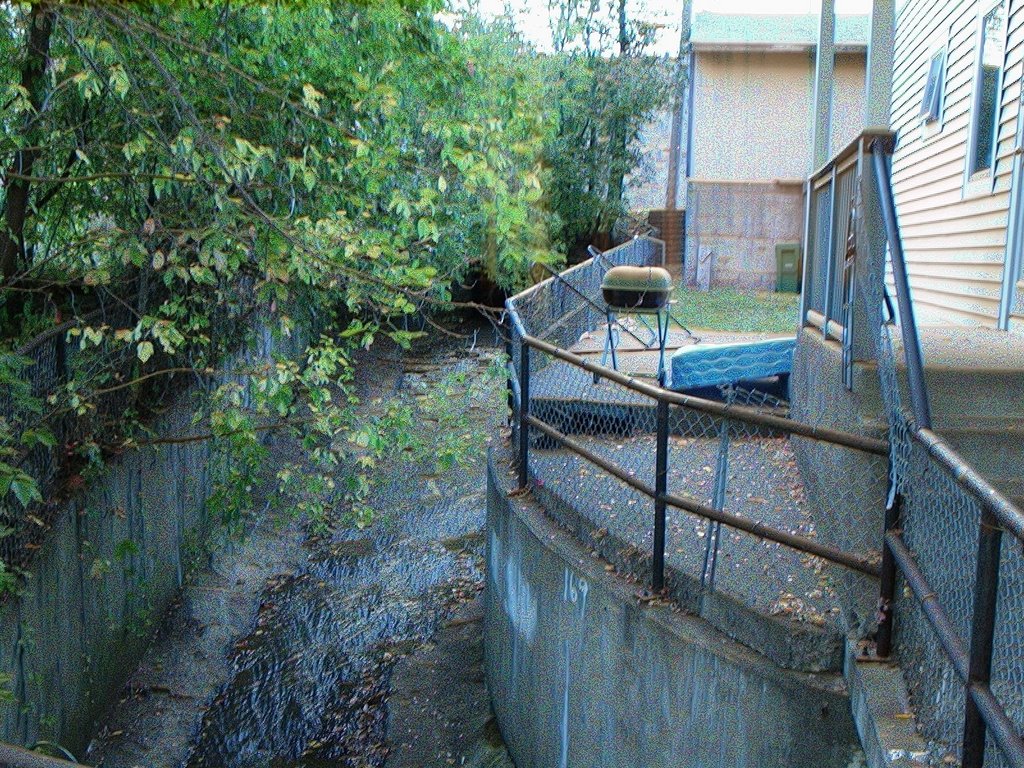
My territory includes a little more than a square mile. My western branch starts up by Central Entrance, in a little wetland behind Taco John’s. I flow past the Marshall School, where my smaller eastern branch joins in. After I cross under Rice Lake Road by the MNDOT office the real fun begins as I race down the steepest part of the hill. The street you call Sixth Avenue East used to be my ravine. These days I disappear from view near the UDAC building, but you can see me again at the lakeshore just below Sir Ben’s.

I had this place pretty much to myself for a long time, flowing free all the way from the heights to Lake Superior. Then around 150 years ago people started cutting down trees, making streets, and putting up buildings all over the hillside.

For a while these folks found me useful. Back in about 1859 Duluth’s first brewery was built on my western bank between Seventh and Eighth Avenue East, just above what is now the “freeway.” The brewery used my water for making beer, so folks started calling me Brewery Creek.

About 20 years later, there was a big rain storm, and I had to move a lot of water down the hill really fast. I was just doing my job, but I got a little carried away and washed out a piece of the hill under the brewery. Part of the building fell down and lots of beer got spilled. Mr. Fink, who ran the brewery, wasn’t very happy about it, so he decided to build a new place down on the lakeshore. He sold that building a few years later to two men – Mr. Fitger and Mr. Anneke. I hear they still make beer there, although they don’t use my water anymore.

Back in those days nobody had cars. Most things were moved around in carriages that were pulled by horses and mules. It was pretty hard for them to cross me, so bridges were built on some of the streets. As I remember it, there was a bridge on East Sixth Street and another one on East Tenth Street. I didn’t mind the bridges because I could still see the daylight and talk to all the critters that came to visit me. But from East Fifth Street on down the hill to Superior Street, the engineers decided to cover me up completely so they could just build streets and not worry about bridges. They put me in big brick and concrete tunnels and covered the tunnels with dirt. Goodbye daylight!

It got even worse when people started driving cars. They got annoyed when they couldn’t cross me at the streets that didn’t have bridges. I was in the way of progress, so the engineers kept working. During the early 1900s they built more tunnels, which got longer and longer. Piece by piece, they put me in the tunnels and covered me up. By the end of the 1920s I was in the dark most of the way from Tenth Street to the lake. Eventually the folks living in the hillside forgot all about me because they couldn’t see me. Some folks even built houses and gas stations right on top of me!Well, even though you don’t see me any more, I still do my job of carrying water to Lake Superior.

I have more stories to tell, like all the fun I had in 1972 when three big storms came through the hillside. But I hear there’s some rain coming, so I’d better get back to work now. I’ll tell you more next time!